
Why High Performers Still Feel Stuck
Why High Performers Still Feel Stuck. You hit every milestone, yet something feels off. Let's talk about that.
You hit every milestone, yet something feels off. Let's talk about that.
Let me guess.
From the outside, your life looks pretty good. Solid career. Decent income. Probably a coffee order that costs more than it should. You've hit the goals you set for yourself — or at least most of them — and you're still standing, which honestly counts for something.
And yet.
There's this quiet, nagging thing that follows you around. It shows up on Sunday nights. It shows up when someone asks "so what's next for you?" and you give a perfectly reasonable answer that you don't actually believe. It shows up when you're lying in bed, exhausted, but your brain won't let you rest.
You're not falling apart. You're functional. You're fine.
But fine is not what you signed up for.
If that's resonating, I want you to know something: you are not broken, ungrateful, or behind. What you're experiencing has a name — and it's a lot more common than people admit out loud, especially in boardrooms and on LinkedIn.
Your brain is working exactly as designed (unfortunately)
Here's some neuroscience that's going to feel a little too accurate:
Dopamine — the brain's reward chemical — spikes during the pursuit of a goal. The planning, the hustle, the climb. Once you actually achieve the thing? Your brain pretty much shrugs and starts scanning for the next target.
Researchers call this the hedonic treadmill. The better you get at achieving things, the faster the treadmill moves, and the harder it becomes to feel satisfied at any given speed.
So that promotion you worked toward for two years? You felt amazing for about three weeks, then it became Tuesday again.
This isn't a character flaw. It's biology. But it does explain why so many high-performing professionals feel like they're always almost there — and never quite arriving.
The identity piece (and this is the one that stings a little)
Simon Sinek said something that I come back to constantly: "Most of us live our lives by accident — we live as it happens. Fulfillment comes when we live our lives on purpose."
Here's what that means in practice: most of us inherited our definition of success. We were handed it in our twenties by our parents, our culture, our industry, or whoever we were trying to impress at the time. And then we spent the next decade (or two) executing that definition with everything we had.
And we're good at it. That's the problem.
Over time, you don't just do high performance — you become it. You are The Reliable One. The Person Who Has It Together. The one people come to when things need to get sorted.
It's a great reputation. It's also a cage, if the version of success you've been performing no longer fits who you actually are.
I've watched this play out over 15 years in HR and leadership. Incredibly capable people, stuck — not because they lack ability, but because they've outgrown a version of themselves they never had time to examine.
The fear under the restlessness
Jay Shetty said it best: "You're not stuck. You're actually grieving a past version of yourself. Reality has moved on — but you've held on."
This is the part people don't say at dinner parties.
For a lot of high achievers, staying busy isn't just a habit — it's armor. As long as there's a goal to chase, a metric to hit, a project to save, you don't have to sit with the harder questions:
Do I actually want this? Is this the life I'm choosing — or the life that happened to me? If I stripped away the job title, who would I be?
Those questions feel threatening when your identity is built around performance. Because what if the answer is I don't know?
Spoiler: that's not a crisis. That's the beginning of something better.
Real talk: what this actually looks like day to day
In case you need a mirror, this is what being "successfully stuck" tends to look like in real life:
"I should be happier." You have things other people want, and you feel guilty for not being more grateful. So you just... keep going.
"I'm exhausted, but not from working too hard." It's a different kind of tired. The kind that a vacation doesn't fix and sleep barely touches.
"I'll figure out what I really want — after this busy season / this project / this raise." (The busy season ends. A new one starts. The deeper question gets deferred again.)
"I've read all the books. I know what I should do. I still can't seem to do it." This one is extremely common with smart, self-aware people. Knowledge is not the gap. Something else is.
"I don't necessarily want to quit. I just don't want to keep doing this." The job might not even be the problem. The misalignment goes deeper.
Sound familiar? Welcome to the club nobody advertises.
This isn't a productivity problem
Here's what 15 years in HR — and a lot of personal reinvention of my own — has taught me: the professionals who stay stuck the longest are not the ones who lack ambition or skill.
They're the ones who are too busy performing to pause and ask why.
They mistake motion for momentum. They mistake achievement for fulfillment. And they wait, sometimes for years, for some external signal to tell them it's okay to want something different.
So here it is, plainly: it is okay to want something different. Right now. Without waiting for permission.
The gap between where you are and where you actually want to be doesn't close by working harder at the wrong thing. It closes when you get honest about what the right thing even is.
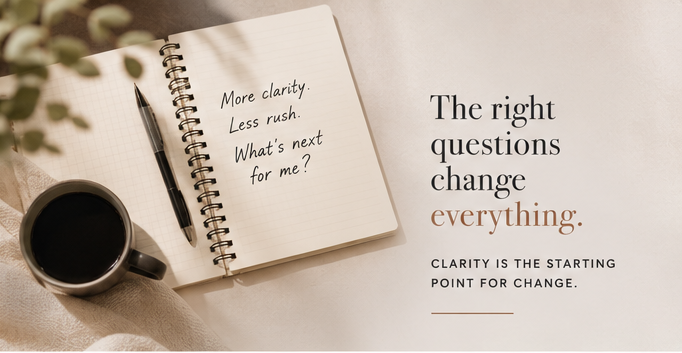
That's the work. Not more hustle. More clarity.
So. What now?
If you read this whole thing nodding your head — or maybe holding your breath a little — that's not an accident. That restlessness is information, not a malfunction.
You don't need to blow up your life. You don't need to quit your job on Monday. You need to start asking better questions, with someone in your corner who'll help you answer them honestly.
That's exactly what I do.
I'm a CPHR with 15 years of HR and leadership experience, a certified life coach, and someone who has navigated my own fair share of reinvention — personally and professionally. I'm not here to hype you up and send you on your way. I'm here to help you actually figure out what's next, and build a real plan to get there.
If you're ready to stop running on the treadmill and start choosing the direction — let's talk.
